Think EDR, but for CI/CD: open source cicd-sensor on GitHub Actions

Ask an engineering or infrastructure team what is happening inside their CI/CD pipeline at runtime. The answer is usually a blank stare. Artifact signing, SBOMs, and locked Actions deps matured. Runtime insight into the job itself lagged behind.
Short answer: an EDR for GitHub Actions is a runtime agent on the runner that watches what the job actually does (processes, network, often file activity) and can alert or stop bad behavior the way endpoint EDR does on laptops. StepSecurity Harden-Runner owns that framing for most teams. cicd-sensor is the open-source EDR for GitHub Actions (and GitLab CI) I wanted when private-repo and fleet features sat behind a paywall or half-finished repos.
I have cared about CI/CD runtime security for a long time. The first tool that looked like a real answer was Harden-Runner: EDR-shaped coverage for GitHub Actions. Solid product. Free for public repos. Private and fleet features sit behind paid tiers. Fair for a company shipping that depth.
Then I looked for open source alternatives. Most were littered: unmaintained, half-finished, or awkward enough that you had to glue two workflows together just to get a signal. I told myself that when I had time I would build or contribute to something better.
Around June I found falco-actions for runtime detection in CI. I joined the public Falco Slack and floated an enforcement idea: when an outbound-connection rule fires after secret access, do not only alert. Drop the destination before exfil finishes (companion script / iptables DROP, or something better on the modern_ebpf path).
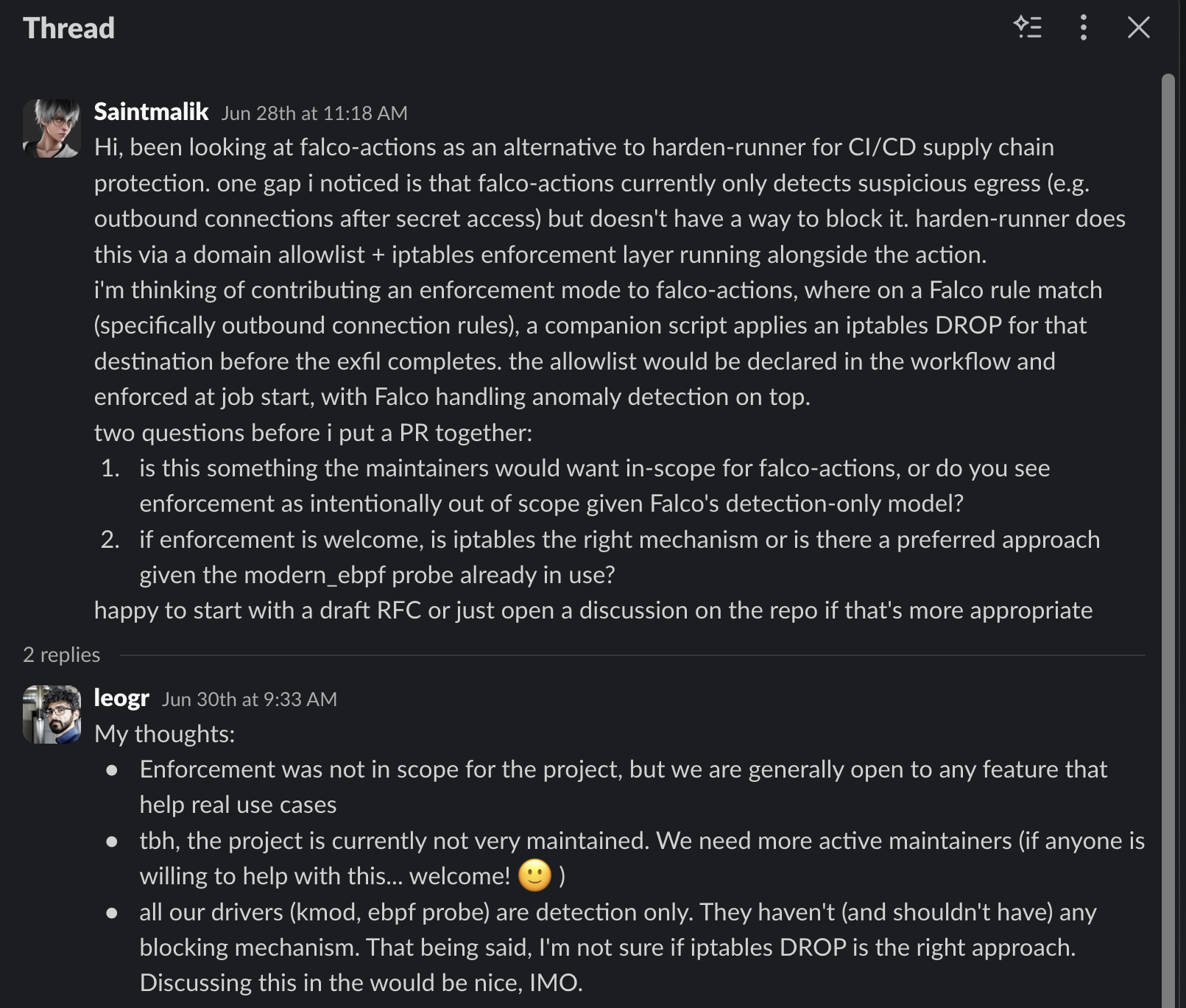
Public Falco Slack thread: proposing enforcement for falco-actions. Drivers stay detect-only. The Actions project needed maintainers more than a block path.
That matched what I already sensed. Falco’s probes are detection-shaped. Stop-the-exfil in CI was not the ready story there yet.
Recently I dug again and found someone with the same itch already shipping: cicd-sensor, started by Hiroki Suezawa around May 2026. Open source eBPF runtime security for GitHub Actions and GitLab CI, including self-hosted and ARC-style fleets. Detect, respond, and audit the pipeline job itself.
I started contributing: first PR open, and several issues filed (OIDC for Manager auth, Azure outputs, ARC Kubernetes-mode hook template overwrite, AKS node matrix).
cicd-sensor covers GitHub Actions and GitLab CI. GitLab Runner Docker executor is a supported target. GitLab Kubernetes executor is in preview (same docs tree as ARC). This post is GitHub Actions only: the three runner shapes below. For GitLab, start from the user guide overview.
| This post covers | Notes |
|---|---|
| GitHub-hosted | Action drop-in, standalone artifacts |
| Self-hosted on a machine | Agent + Docker proxy + Manager + job hooks |
| ARC on Kubernetes | DaemonSet + hooks, preview in upstream docs |
The project is still pre-release and moving fast. Prefer a workflow dependency lockfile (or pin the action SHA if you are not on lockfiles yet). Treat Manager and ARC paths as ops work, not a one-line Action drop-in.
If you already read Runtime Trace attestation, this is the broader sensor story. That post is process attestation as a gate. This one is how you get continuous visibility and optional terminate on the runner fleet.
What cicd-sensor actually is
cicd-sensor is an eBPF agent aimed at CI runners, not at long-lived production nodes as a general EDR. It observes process, network, and related job activity, applies baseline rules by default, and can emit:
- HTML job reports and Runtime Trace attestation predicates (especially useful on GitHub-hosted)
- Summary / Detection / Runtime Event Logs (when a Manager is in the path)
- Rule actions:
detect,collect, orterminate
What it can stop. Rule action: terminate attempts to stop the job (kill the offending process / cut the run short). Start with detect, or keep monitor_mode: true so terminate rules behave as detect until you trust the noise floor.
What it is not. It is not a network firewall. Upstream is explicit: cicd-sensor does not default-deny egress with an allowlist the way Harden-Runner or CargoWall do. On a bad network or process match it responds by terminating, not by filtering traffic. If you need “only these domains leave the runner,” keep an egress product. If you need “this process tree + credential read + weird connect should kill the job,” that is cicd-sensor’s lane.
Kernel bar (from upstream docs):
- amd64: Linux 5.15+, with BTF at
/sys/kernel/btf/vmlinux - arm64: Linux 6.1+ (fentry/trampoline landed later on arm64)
- cgroup v2 where the machine / node setup expects it
ubuntu-slim and similar “container on a shared VM” hosted labels are not supported: there is no host eBPF environment for the agent.
Two usage models matter:
- GitHub-hosted standalone. Add
cicd-sensor-actionto the job. Local.cicd-sensor/config optional. Artifacts out of the job. Manager optional for fleet logs. - Machine / Kubernetes + Manager. Agent (and Docker proxy or DaemonSet) on the host/node. Config, rules, and log shipping go through Manager. Required for self-hosted machine and ARC.
Path 1: GitHub-hosted runners
This is the shortest path. Official guide: GitHub-hosted runner.
Lock the action (or pin a SHA). Example from current docs. Check the latest release before you copy:
jobs:
  build:
    runs-on: ubuntu-24.04
    steps:
      - uses: cicd-sensor/cicd-sensor-action@6511eb44c91d71b2b93d71193b1bf2cb18352f66 # v0.0.38
      - uses: actions/checkout@...
      # rest of the job
Put the action first so it covers the whole job. It is fine before actions/checkout.
Supported labels include ubuntu-latest, ubuntu-24.04, ubuntu-22.04, and the arm variants. Third-party hosts (Blacksmith, BuildJet, etc.) need a BTF check. Blacksmith x86_64 is called out as supported from v0.0.38. ARM64 Blacksmith without BTF is not.
Standalone: what you get
Without Manager, the agent runs inside the job and uploads an HTML report (and by default a Runtime Trace attestation predicate) as artifacts. Signing that attestation is a separate step (actions/attest or Cosign) if you want a signed predicate on the subject.
Project-local tuning lives under:
repo/
  .cicd-sensor/
    config.yaml
    rules/
      example.yaml
Example config.yaml for a careful first rollout:
default_max_alerts_per_rule: 20
disable_baseline_rules: false
monitor_mode: true   # treat terminate rules as detect
Custom rule sketch:
rule_sets:
  - ruleset_id: acme/github-hosted
    rules:
      - rule_id: curl_exec
        rule_name: "curl executed"
        event_type: process_exec
        condition: process.exec_path.endsWith("/curl")
        action: detect
A terminate rule looks the same with action: terminate. Keep monitor_mode: true until you mean it.
Validate rules before you rely on them:
cicd-sensorctl rule validate .cicd-sensor/rules
Baseline rules still apply even when you have no local rule files. Keep them on unless you have a reason to opt out.
Optional: Manager from hosted jobs
When you set manager-url and manager-token, logs can leave the job into cloud outputs / SIEM. Important behavior: repository-local .cicd-sensor/ is not used once Manager is configured. Config and rules come from the manager only. Store the token as a GitHub Actions secret.
- uses: cicd-sensor/cicd-sensor-action@6511eb44c91d71b2b93d71193b1bf2cb18352f66 # v0.0.38
  with:
    manager-url: https://cicd-sensor-manager.example.com
    manager-token: ${{ secrets.CICD_SENSOR_MANAGER_TOKEN }}
Path 2: Self-hosted runner on a machine
On a long-lived (or ephemeral) machine runner, a one-shot Action is not enough. You install the Agent and Docker proxy on the host, point them at Manager, then wire GitHub job hooks so each Actions job gets a start/end lifecycle.
Follow in order:
Running only a long-lived Agent without Manager is not a supported target for this path.
Host install (short version)
Prereqs: supported kernel + BTF, cgroup v2, systemd, dockerd. Outbound HTTPS to your Manager URL.
Unpack a release into /opt/cicd-sensor and rename arch-suffixed binaries to cicd-sensor, cicd-sensor-manager, cicd-sensorctl as documented.
Store the manager token:
sudo install -d -m 0750 /etc/cicd-sensor
echo "MANAGER_TOKEN_HERE" | sudo tee /etc/cicd-sensor/manager-token >/dev/null
sudo chmod 0600 /etc/cicd-sensor/manager-token
Agent systemd unit (GitHub machine runner):
# /etc/systemd/system/cicd-sensor-agent.service
[Unit]
Description=cicd-sensor Agent
After=network-online.target
Wants=network-online.target
RefuseManualStop=yes
IgnoreOnIsolate=yes

[Service]
Type=simple
RuntimeDirectory=cicd-sensor
RuntimeDirectoryMode=0755
LoadCredential=manager_token:/etc/cicd-sensor/manager-token
ExecStart=/opt/cicd-sensor/cicd-sensor agent start \
  --provider github \
  --runner machine \
  --manager-url https://cicd-sensor-manager.example.com \
  --manager-token-file ${CREDENTIALS_DIRECTORY}/manager_token
Restart=always
RestartSec=5s
NoNewPrivileges=yes
PrivateTmp=yes
OOMScoreAdjust=-1000
KillMode=mixed
TimeoutStopSec=5s

[Install]
WantedBy=multi-user.target
sudo systemctl daemon-reload
sudo systemctl enable --now cicd-sensor-agent.service
Docker needs a proxy in front of the socket so container creation is attributable. Real dockerd moves to /run/docker-upstream.sock. Clients keep talking to /run/docker.sock served by cicd-sensor proxy dockerd. See the install doc for the docker.socket override and cicd-sensor-docker-proxy.service. The proxy is observation for attribution, not an authorization boundary. Treat socket access like Docker root.
Job hooks
GitHub runs scripts before/after each job when these env vars point at absolute paths:
| Hook | Role |
|---|---|
ACTIONS_RUNNER_HOOK_JOB_STARTED | cicd-sensor host start |
ACTIONS_RUNNER_HOOK_JOB_COMPLETED | cicd-sensor host end |
Create hooks under /opt/cicd-sensor:
sudo sh -c 'printf "%s\n" "#!/usr/bin/env sh" "/opt/cicd-sensor/cicd-sensor host start" > /opt/cicd-sensor/github-job-started.sh && chmod 0755 /opt/cicd-sensor/github-job-started.sh'
sudo sh -c 'printf "%s\n" "#!/usr/bin/env sh" "/opt/cicd-sensor/cicd-sensor host end" > /opt/cicd-sensor/github-job-completed.sh && chmod 0755 /opt/cicd-sensor/github-job-completed.sh'
Scope them per runner via the runner directory .env (example install path /opt/actions-runner):
cd /opt/actions-runner
cat >> .env <<'EOF'
ACTIONS_RUNNER_HOOK_JOB_STARTED=/opt/cicd-sensor/github-job-started.sh
ACTIONS_RUNNER_HOOK_JOB_COMPLETED=/opt/cicd-sensor/github-job-completed.sh
EOF
sudo ./svc.sh stop
sudo ./svc.sh start
If the start hook exits non-zero, the job never runs. The completed hook’s health check is also a tamper signal: if something inside the job called host end early to cut monitoring short, finalize fails and the job does not look clean.
Verify with a test workflow, then:
sudo journalctl -u cicd-sensor-agent.service -f
You can still use cicd-sensor-action from workflows on a machine that already has host setup. The durable path is Agent + hooks + Manager.
Path 3: ARC on Kubernetes
Actions Runner Controller scale sets are preview support. Do not treat this like GitHub-hosted maturity yet. Guide: GitHub ARC runner scale sets.
You need Manager, node prerequisites (cgroup v2, containerd NRI, runc systemd cgroups, documented in Kubernetes runner install), and an existing ARC install. cicd-sensor runs as a privileged node DaemonSet. Job hooks are fail-closed: if the agent or GitHub Kubernetes runner socket is missing on a node, jobs on that node can fail before steps run.
Pick the mode that matches your scale set:
| ARC mode | When | cicd-sensor pieces |
|---|---|---|
| Default | No containerMode. Job runs in the runner container | DaemonSet + job hook + runner socket mount |
| dind | docker build / Compose style | Same pattern + containerMode.type: dind |
| Kubernetes | container: / services / container actions as Pods | DaemonSet + NRI + job hook + container hook wrapper |
Shared bootstrap
kubectl create namespace cicd-sensor-system --dry-run=client -o yaml | kubectl apply -f -
kubectl create namespace arc-runners --dry-run=client -o yaml | kubectl apply -f -

kubectl -n cicd-sensor-system create secret generic cicd-sensor-manager \
  --from-literal=token="${CICD_SENSOR_MANAGER_TOKEN}" \
  --dry-run=client -o yaml | kubectl apply -f -
Ensure the ARC runner namespace allows the hostPath used for the GitHub Kubernetes runner socket if Pod Security Admission is strict.
Values merge rule (read this before Helm)
Do not pass “existing ARC values” and “cicd-sensor example” as two --values files. Helm deep-merges maps. Lists are replaced. Runner env, volumeMounts, and volumes are lists. A second file can silently drop either your settings or the sensor mounts.
Copy the example for your mode from examples/kubernetes/github-arc/, merge into one file (cicd-sensor-arc-values.yaml), pin image tags (examples use :latest only as placeholders), set CICD_SENSOR_MANAGER_URL on the DaemonSet, then:
kubectl apply -f cicd-sensor-daemonset.yaml
kubectl apply -f cicd-sensor-job-hook.yaml
# kubernetes mode also: cicd-sensor-container-hook-wrapper.yaml

helm upgrade --install RUNNER_SCALE_SET_NAME \
  oci://ghcr.io/actions/actions-runner-controller-charts/gha-runner-scale-set \
  --namespace arc-runners \
  --version ARC_CHART_VERSION \
  --values cicd-sensor-arc-values.yaml
Default-mode runner env / mounts look like this (from upstream example. Merge. Do not paste blindly over a production values file):
template:
  spec:
    containers:
      - name: runner
        image: ghcr.io/actions/actions-runner:latest
        command:
          - /home/runner/run.sh
        env:
          - name: ACTIONS_RUNNER_HOOK_JOB_STARTED
            value: /opt/cicd-sensor/job-hooks/github-k8s-job-started.js
          - name: CICD_SENSOR_GITHUB_K8S_RUNNER_SOCKET
            value: /run/cicd-sensor/github-k8s/runner.sock
        volumeMounts:
          - name: cicd-sensor-github-arc-job-hook
            mountPath: /opt/cicd-sensor/job-hooks
            readOnly: true
          - name: cicd-sensor-github-k8s-runner-socket
            mountPath: /run/cicd-sensor/github-k8s
    volumes:
      - name: cicd-sensor-github-arc-job-hook
        configMap:
          name: cicd-sensor-github-arc-job-hook
          defaultMode: 0555
      - name: cicd-sensor-github-k8s-runner-socket
        hostPath:
          path: /run/cicd-sensor/github-k8s
          type: DirectoryOrCreate
Do not mount host containerd.sock, CRI/NRI sockets, or /run/cicd-sensor internal sockets into workflow-created job/service/step Pods. The GitHub Kubernetes runner socket into the ARC runner container is the documented exception.
Verify
kubectl -n cicd-sensor-system rollout status daemonset/cicd-sensor
kubectl -n cicd-sensor-system logs daemonset/cicd-sensor -c agent
# kubernetes mode: also -c nri → look for nri_observer_starting / nri_staging_put
After a job starts you want github_k8s_start_accepted in agent logs. Confirm the runner Pod has the hook env and /run/cicd-sensor/github-k8s mount, then run a workflow with runs-on set to your scale set name and watch Manager.
I have been pushing on AKS node image verification for this path (community docs PR and issues for a wider verified matrix). Preview means “works in documented shapes,” not “every cloud node image is certified.”
How I would roll this out
- Public or low-risk hosted job. Lock or pin
cicd-sensor-action, leave baseline on,monitor_mode: true, read the HTML report for a week. - Add one custom detect rule that matches a known bad pattern you care about (unexpected curl/wget to odd destinations, unexpected crypto miners, etc.), still detect-only.
- Private fleet. Stand up Manager (Lambda / ECS / Cloud Run / k8s Deployment. Project ships images on GHCR). Point hosted jobs at Manager when you want SIEM delivery. For self-hosted and ARC, Manager is mandatory.
- Terminate later. Turn off
monitor_modeonly after false positives are boring. - Attestation. On hosted jobs, take the Runtime Trace predicate artifact and sign/verify it in promote gates the same way you would any other in-toto predicate (related post).
Harden-Runner vs cicd-sensor
Teams searching “EDR for GitHub Actions” land on Harden-Runner first, and for good reason. This table is the honest split, not a dunk.
| Harden-Runner (StepSecurity) | cicd-sensor | |
|---|---|---|
| Framing | “Works like an EDR for GitHub Actions runners.” They coined the category language most SERPs repeat | “Think EDR, but for CI/CD.” Same job class, open-source first |
| License / data path | Community agent open for public Linux. Enterprise / Windows / macOS / self-hosted agents are commercial. Events go to StepSecurity’s cloud for the polished dashboard | Fully open source. Self-host Manager. Your logs stay in your sinks (S3, GCS, Azure, Pub/Sub, etc.) |
| Response | Egress allowlist / block at the network layer | Rule detect / collect / terminate (kill process / stop job). Not a default-deny firewall |
| Best fit | Drop-in Action, egress UI, Windows + macOS, incident history (tj-actions, Shai Hulud, etc.) | Open-source EDR for GitHub Actions + GitLab. Custom rules. Runtime Trace attestation. Private fleets without a SaaS meter |
| Maturity | Production-hardened, huge install base | Pre-release, moving fast. Lock or pin deps. Treat ARC/Manager as ops |
| Not | A free private-fleet EDR with no commercial tier | A clone of Harden-Runner’s egress product or dashboard |
Pick Harden-Runner when you want polished egress enforcement and a vendor dashboard tomorrow. Pick cicd-sensor when you need an open-source EDR for GitHub Actions you can self-host, extend with rules, and keep telemetry inside your boundary. Many programs will use both layers over time (static lock + egress + sensor), not one forever.
Also not:
- A replacement for locking Actions deps, least-privilege
GITHUB_TOKEN, and static workflow lint (hardening post). - Production-node Falco/Tetragon with a CI sticker. The lifecycle hooks and Docker/NRI attribution are the CI-specific hard parts.
FAQ
What is an EDR for GitHub Actions?
Endpoint detection and response for CI: a runner agent that observes process, network, and related activity during a workflow job, correlates it to the run, and can detect or stop suspicious behavior. Classic laptop EDR does not understand ephemeral runners or workflow steps. CI-shaped tools do.
Is there an open source EDR for GitHub Actions?
Yes. cicd-sensor is an open-source eBPF runtime security sensor for GitHub Actions and GitLab CI. Harden-Runner’s community Linux agent is also open for public repos, but private-repo enforcement, Windows/macOS, and the full fleet product sit on StepSecurity’s commercial path. Other open projects (CargoWall, Legion Runner, Falco Actions) cover parts of the space (egress firewall, syscall rules) without always matching the full “EDR for the job” brief.
Can cicd-sensor block or stop a job?
Yes, via action: terminate. Upstream docs say terminate attempts to stop the job. That is process/job kill on a rule hit, not iptables-style egress deny. With monitor_mode: true, terminate is treated as detect so you can roll out safely.
Harden-Runner or cicd-sensor?
Harden-Runner if you want the category-defining product, egress block, and multi-OS polish. cicd-sensor if you want fully open source, self-hosted Manager, GitLab coverage, Runtime Trace attestation, and rule-driven terminate. See the comparison table above.
Does cicd-sensor replace locking Actions and egress allowlists?
No. It watches (and can terminate) what the job does after you already locked deps and tokens. Pair it with static hardening (supply-chain hardening post) and, where you need default-deny egress, Harden-Runner or CargoWall.
Contribute / follow
- Project: github.com/cicd-sensor/cicd-sensor
- Action: cicd-sensor/cicd-sensor-action
- Docs entry: User guide overview
CI runtime should not stay a blank stare. cicd-sensor is the open sensor I wanted when I was staring at paid-only and abandoned options. Hosted is a one-step start. Machine and ARC need Manager and honest ops. That is the right shape for something that can detect, terminate, and leave an audit trail of what the pipeline actually did.